

Thangka making is an exquisite traditional craft. From selecting the canvas to consecration, each step embodies the wisdom and devotion of the painter. The entire process consists of 12 key steps, each crucial, working together to create a complete Thangka work that embodies both religious significance and artistic value.
Making Process
Selecting Canvas
Choose high-quality white or cream-colored cotton cloth, requiring tight texture, slight elasticity, smooth surface without damage or stains. This is the foundation for Thangka painting.
Assembling Frame
According to the canvas size, join four wooden sticks (usually pine) into a rectangular frame using mortise and tenon joints, stretch the canvas tightly and fix it on the frame, making it flat like a drum surface.
Applying Primer (Base Coating)
This is a crucial preparatory step. The purpose is to fill fabric pores, making it smooth and non-absorbent. Mixing: Melt traditional ox glue with clear water, mix with fine white mineral powder in proportion (water:powder:glue ≈ 3:2:1), filter into uniform slurry. Brushing: Use a wide brush to evenly apply the slurry on both sides of the canvas, following top-to-bottom, left-to-right order, ensuring uniform thickness. After drying, check and touch up uneven areas.
Polishing Canvas
Make the canvas surface extremely smooth and fine, suitable for detailed painting. Wet polishing: Place a board on the front of the canvas, brush with clear water, then repeatedly polish with smooth pebbles or agate stones until the slurry mixture becomes fine and the surface smooth as paper. Dry polishing: Flip the canvas, polish the back without water, making it flat. When complete, tapping the surface should produce a crisp sound.
Making Brushes
Due to the need for extremely fine brushstrokes, some brushes must be handmade. Selecting bristles: Carefully select weasel tail hair, remove downy hair, keep strong stiff bristles. Shaping: Place the hair bundle in a mold, align one end, dip in a small amount of melted ox glue to shape the tip. Assembly: Insert the tip into a trimmed bird (eagle/chicken) feather quill, fix with a bamboo stick dipped in glue, finally hand-polish to create a perfect brush tip.
Preparing Pigments
Using natural mineral and plant materials, colors remain unchanged for millennia. Mixing: Place block or powdered mineral pigments (such as cinnabar, malachite, lapis lazuli) in a dish, add clear water and a small amount of ox glue solution (ratio about 2:1:0.5), grind finely with fingers or pestle, mix to moderately thick paste. Color mixing: Can mix basic pigments to obtain rich intermediate colors, each color prepared separately for use.
Drawing Sketch (Line Drawing)
Initial draft: First use charcoal or pencil, strictly following the proportions of the "Iconometric Canon," outline the main and auxiliary contours of the Buddha image (white drawing). Final draft: Then use a fine-tipped brush dipped in ink to precisely outline the charcoal draft into ink lines (black drawing), forming a clear line drawing foundation.
Coloring and Shading
Flat coloring: According to the picture content (Buddha images, scenery), apply the prepared pigments in large areas to corresponding regions. Follow the order of "light before dark, distant before near, clothing before Buddha body." Shading: While colors are still wet, use a water brush for transitional rendering to express light and shadow and layers of objects, making colors vivid.
Outlining and Gold Painting
Re-outlining: After coloring, use related colored lines to outline contours again, distinguishing boundaries. Gold painting: This is an important decorative step. Use gold liquid made from pure gold powder to finely outline the Buddha's clothing patterns, halos, ritual implements, and decorative patterns (called "gold painting"), making the picture suddenly rich and brilliant.
Opening Eyes and Face
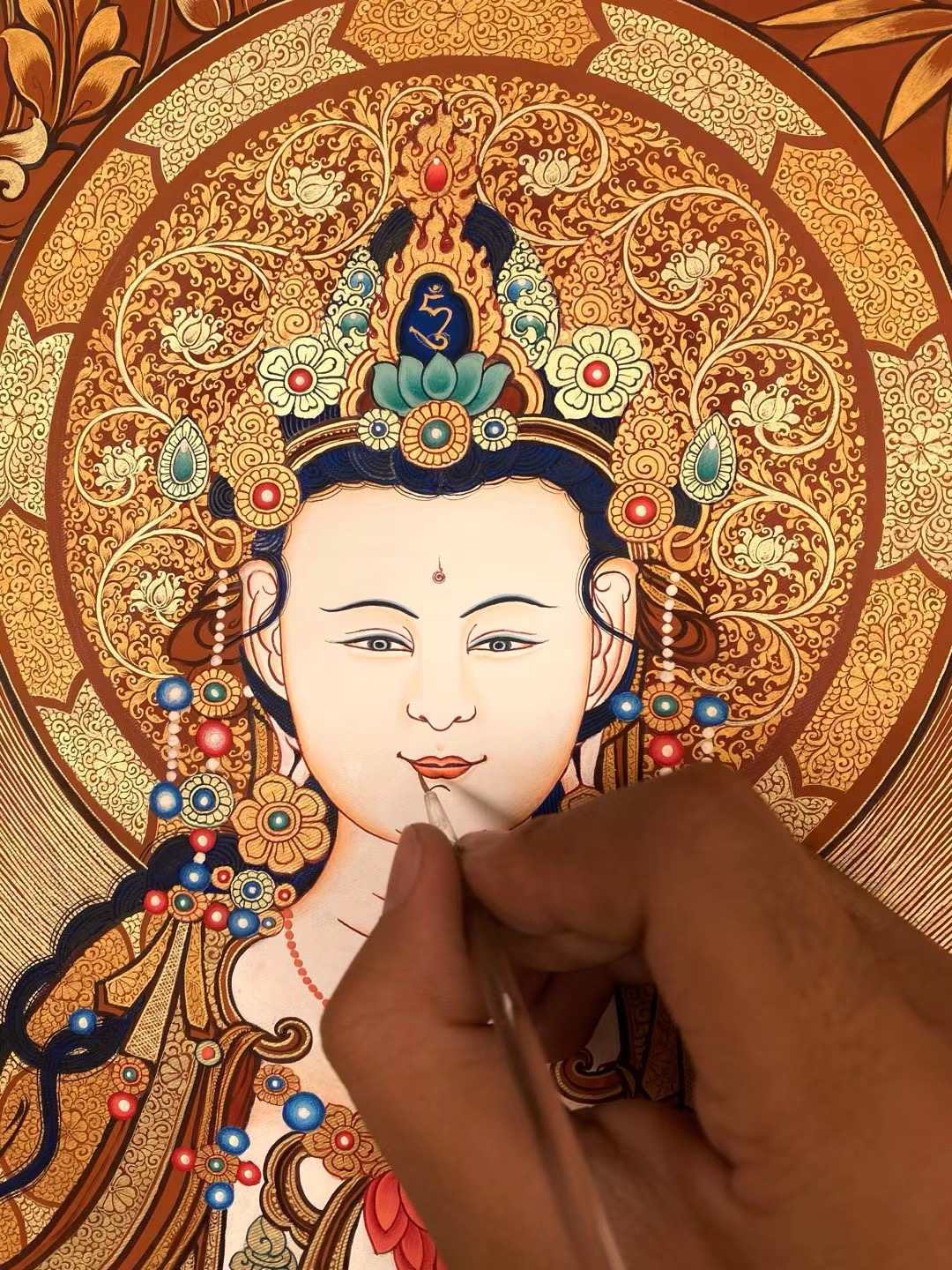
This is the final and most spiritual step, determining the Thangka's divine charm. Timing: Usually performed on an auspicious day. Drawing: The painter concentrates calmly, uses the finest brush to precisely depict the Buddha's eyes, lips, urna (white curl between eyebrows), and other details. In an instant, the Buddha image is endowed with life and spirit.
Mounting
To protect and enhance the Thangka. Edging: First edge the painting center with multiple layers of colorful brocade "teeth" (symbolizing rainbow), then sew large pieces of "heaven pool" (top), "earth jade" (bottom), and left-right side panels of high-quality brocade edging around the periphery. Installing rods: Install round wooden "scroll rod" (with decorative finials) at the bottom of earth jade, install flat wooden "lintel rod" at the top of heaven pool, convenient for rolling and hanging.
Consecration
To make the Thangka a spiritual sacred object. Installation: On the back of the Thangka, at the heart, throat, and forehead positions corresponding to the Buddha image, write Sanskrit seed syllables (such as Om, Ah, Hum) with cinnabar or gold liquid. Chanting: Invite high monks and masters to chant mantras, through specific rituals "invite" the Buddha's wisdom and compassion into the painting. Worship: After consecration, the Thangka can be enshrined in temples or monasteries, becoming an object of practice and worship. At this point, a complete Thangka work that embodies both religious significance and artistic value is finally born.